The Image of the Tower of Babel

When Marduk heard the speech of the gods,
his heart compelled him to create artful things.
He spoke the work of his words to Ea,
what he thought in his heart, he offered in counsel:
‘I will weave blood, I will bring about bone,
and I will make a creature – let his name be ‘Human.’
I will create the human creature,
that the toil of the gods be imposed upon them, so that the gods may rest.— Enuma Elish (Tablet VI)
In Genesis 11, a united humanity sharing “one language, and one speech” settles in the plain of Shinar. They begin to build a city and a tower “with its top in the heavens,” so they might “make a name for [themselves], else [they] shall be scattered all over the world.” The God Yahweh, observing “nothing that they may propose to do will be out of their reach,” confounds their language with a magic word and scatters them across the earth. The project remains forever incomplete.
Genesis provides neither a physical description of the tower nor an account of its collapse. Every culture that inherits the story projects its own imaginings onto it. The Book of Jubilees, an ancient Jewish apocryphal text held canonical by various Ethiopian and Eritrean Orthodox Christian denominations as well as Beta Israel, states that the tower was built in forty-three years, and “its breadth was 203 bricks, and the height (of a brick) was the third of one; its height amounted to 5433 cubits and 2 palms, and (the extent of one wall was) thirteen stades (and of the other thirty stades).” (Jubilees 10:26). Its end is described similarly as in Genesis, but details the nature of the towers fall: “And the Lord sent a mighty wind against the tower and overthrew it upon the earth, and behold it was between Asshur and Babylon in the land of Shinar, and they called its name ‘Overthrow’” (Book of Jubilees 10:21-10:26). The sixth-century historian Gregory of Tours, quoting Orosius, described the tower as “laid out foursquare on a very level plain,” a massive rectilinear fortification. The seventeenth-century antiquarian Richard Verstegan, citing Josephus, purported that the tower was wider than it was high, “more like a mountain than a tower,” its spiral path broad enough to contain lodgings for workers and fields for growing grain to feed the animals used in its construction. Bruegel’s influential paintings model the tower on the Roman Colosseum—its architectural components, art historian Joanne Morra (Morra 2007) notes, are “a motley composite” of Near Eastern and Romanesque forms, a spiral ramp rising heavenward from a solid foundation . Gustave Doré’s later conical depictions resemble the Malwiya, the great spiral minaret of the ninth-century Abbasid capital Samarra. Each epoch and culture that encounters the tower sees something different in it.1
The story of Babel is anchored in the material and political reality of ancient Mesopotamia. Babylon was the seat of successive empires, and its monumental ziggurats functioned as ritual structures linking heaven and earth. Among these was E-temen-anki, whose name translates as “House of the Foundation Platform of Heaven and Underworld.” Built in honor of the patron deity Marduk, the ziggurat is widely considered the architectural and symbolic basis for later imaginings of the Tower of Babel (George 2005). The Koine Greek exonym Babylon derives from the Akkadian Bab-ilim, “Gate of the god.” The biblical etiology of Babel hinges instead on a pun: Babel is linked to the Hebrew balal, “to confuse.” As Morra notes, following Derrida, the word is polysemous, naming God the Father, the city of God, and confusion at once (Morra 2007). Gazed at by successions of the myth’s inheritors, the emblem of the ruined tower, marked by the word Babel, becomes overloaded with interpretation, a ruination of semiotic association that the tower itself often represents.
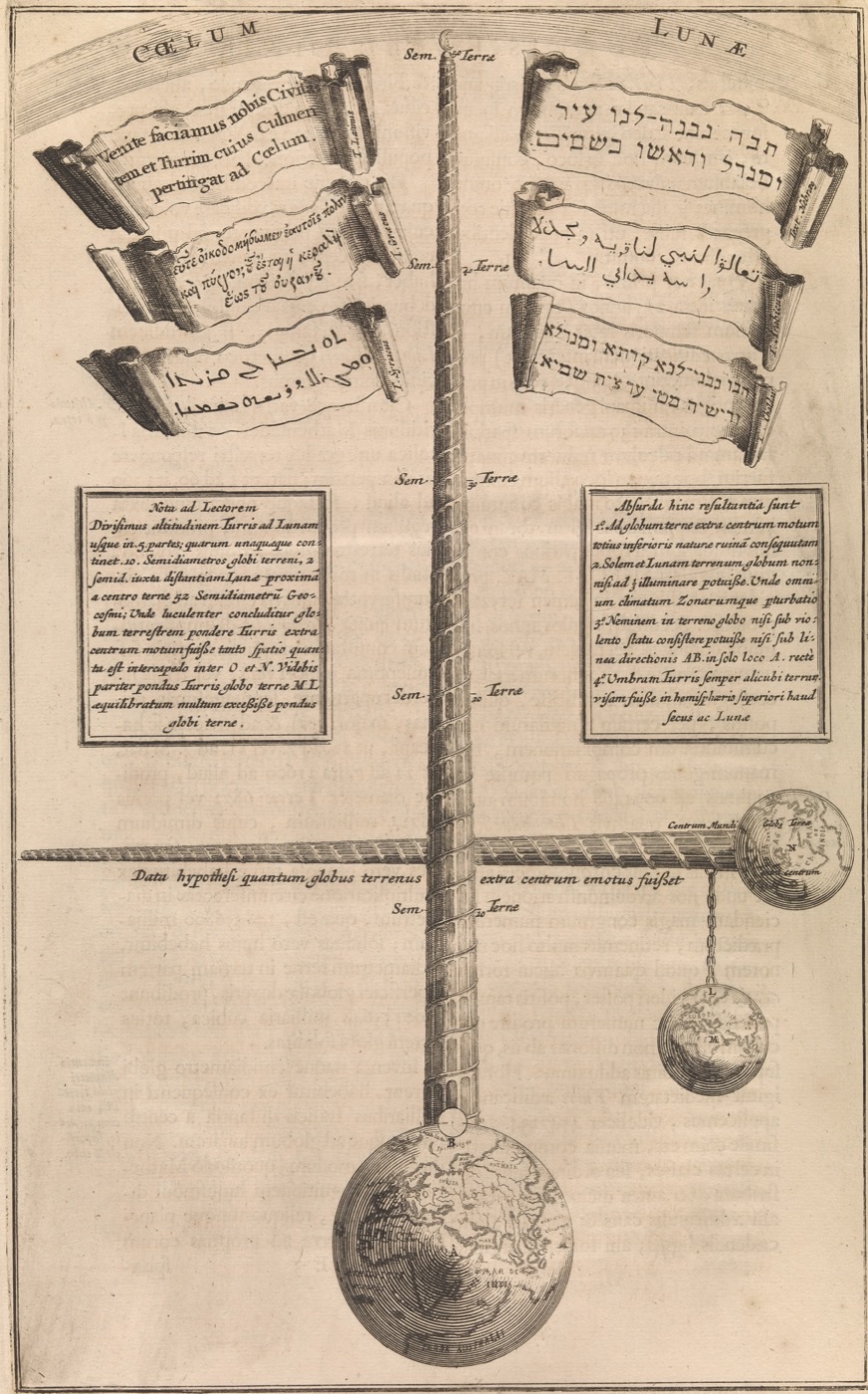
For theorist Northrop Frye, Babel is a “cyclical symbol” of imperial history: the attempt to unify human resources by force and the inevitability of decline (Frye 2008). Its exemplary force depends on Babylon’s historical disappearance.2 In exegesis, Babel’s sin is pride—“let us make a name for ourselves”—and expanded tellings of the story repeatedly aligned with other figures of overreaching ambition: Lucifer, Cain, the antediluvian giants, and Nebuchadnezzar. Read alongside the Table of Nations in Genesis 10, Babel also functions politically.3 As medievalist Tristan Major (Major 2018) has shown, these chapters were used to explain linguistic and ethnic diversity while supporting hierarchies that marginalized non-European and non-Christian peoples. The origin story doubles as a taxonomy, sorting peoples into a “divinely ordered” hierarchy that the tower’s ruin appears to justify.
The Kabbalist Menachem Tsioni, a fifteenth-century Torah commentator, dispensed with any known architecture: The tower was a functional flying craft, powered by antediluvian magic inherited from Nephilim, originally built for holy purposes but corrupted into a weapon of world domination. (New World Encyclopedia 2023).↩︎
Julia Hell identifies “scenarios of imperial ruin gazing” as a recurring structure in European imperial imaginaries: scenes in which the imperial subject contemplates the ruins of a predecessor empire while projecting the fate of their own (Hell 2010, 4). Babylon’s historical disappearance made it an exemplary object for this gaze—a civilization whose monumental ambition could only be read through what it left behind. The structure recurs from Scipio weeping over Carthage to Volney meditating at Palmyra to Spengler predicting the ruin of the West: each gazer sees their own empire’s fate rehearsed in the rubble of another (Hell 2019).↩︎
The Table of Nations (Genesis 10) is a genealogy that, within the biblical narrative, traces all the world’s peoples back to Noah’s three sons, Shem, Ham, and Japheth, in the aftermath of the Flood story. Interpreters have long mapped this genealogy onto real ethnic and geographic groups, Elam to the Elamites, Canaan to the Canaanites, and so on, making it arguably the earliest surviving attempt at a comprehensive human ethnography. From late antiquity through the early modern period, Christian and Jewish scholars generally treated it as an actual record of human descent, and the framework was later weaponized: the “Curse of Ham” was invoked to justify race-based slavery, and it was later still invoked by the architects of apartheid South Africa to justify racial hierarchy.↩︎